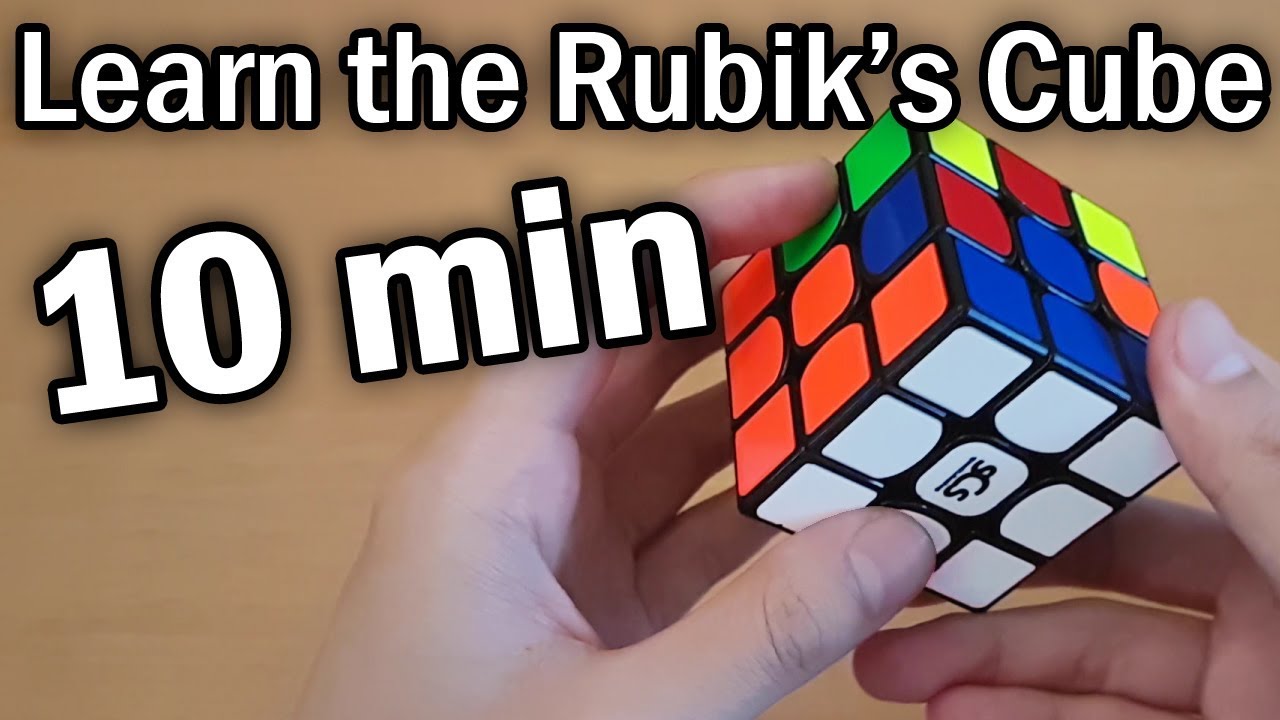
Decoding the Rubik's Cube: From Frustration to Mastery

"Oh, so this is how parents feel when you try to explain new technology to them."

@boalollal242• 6y ago
22.1k

Decoding the Rubik's Cube: From Frustration to Mastery

Invented in 1974 by Hungarian architecture professor Ernő Rubik, the Rubik's Cube began as a humble teaching tool designed to help students grasp three-dimensional geometry. Rubik never anticipated his creation would become the most popular puzzle toy in history. The extraordinary difficulty of the cube stems from its massive scale: a standard puzzle boasts over 43 quintillion possible configurations with only a single solved state.

Randomly twisting the blocks rarely leads to success. Mastery instead requires structured algorithms. While beginners often mistake solving the puzzle for pure intuition, it actually relies heavily on pattern recognition and practiced execution.

The Beginner Method: A Five-Step System

This tutorial bridges that gap by teaching a highly predictable, step-by-step beginner system:

  • Step 1 — The White Cross: Build a cross around the white center piece, ensuring the side colors of those edge pieces perfectly align with the adjacent side centers.

  • Step 2 — The First Layer: Turn the cube upside down and use a foundational four-move sequence (Right Up, Top Left, Right Down, Top Right) to properly drop the white corners into place.

  • Step 3 — The Second Layer: Match non-yellow edges on the top layer to their center color, push them away from their target slot, and use the four-move sequence to slot them into the middle layer.

  • Step 4 — The Yellow Cross: Use a short algorithm to manipulate the top yellow edges from a dot, to an L-shape, to a horizontal line, and finally into a complete cross, adjusting them to match the side centers.

  • Step 5 — Positioning and Orienting Final Corners: Cycle the remaining top corners into their correct locations (even if flipped incorrectly). Finally, turn the cube upside down and repeatedly use the four-move sequence to rotate each corner until the puzzle is solved.

The Community Reacts: Frustration and Triumph

Learning these algorithms is a universal test of patience. Filtering through the community response, these five hand-picked comments perfectly capture the grueling but rewarding process of learning to solve the cube:

  • The Learning Curve: Hero commenter @boalollal242 humorously noted the steep mental hurdle: "Oh, so this is how parents feel when you try to explain new technology to them."

  • The Time Dilation: Hero commenter @jordanwilliams1514 pointed out the brutal reality of the tutorial's title: "10 minute video turned into a couple hours."

  • The Panic: Selected commenter @JenniizCookiez highlighted the anxiety of trying to keep up with the instructor: '"Now pay attention because if you get this wrong you'll mess up the whole cube" goes at the speed of light'.

  • The Ultimate Heartbreak: Selected commenter @miecaf captured the most devastating feeling in cubing: "Nothing hurts more than being on the last step and then messing up the algorithm".

  • The Final Payoff: Despite the intense frustration, Selected commenter @mattnnat1 perfectly summarized the euphoric end result: "This probably doesn't mean anything to anyone but this took me forever but I finally did it and I've never been more happy and proud".

More Than Just a Toy

Ultimately, conquering the Rubik's Cube is a masterclass in patience and algorithmic execution. By breaking down those 43 quintillion possibilities into a predictable five-step system, anyone can transform this notoriously difficult 1974 teaching tool into a deeply rewarding personal achievement.

Do you find this post helpful?

Comments:
The Satire of Faux Profundity: Deep thoughts with The Deep

""Real eyes realize real lies." Truer words have never been spoken, truly a masterpiece by The Peak."

@noxvi6687• 4y ago
68.4k

The Satire of Faux Profundity: Deep thoughts with The Deep

"Deep Thoughts with The Deep" is a recurring parody segment from Amazon's The Boys, where the show's insecure, self-absorbed aquatic superhero delivers a series of faux-profound one-liners with total sincerity. The joke thrives on how hollow and nonsensical the "wisdom" actually is once you think about it for more than a single second. The segment serves as a razor-sharp satire of the modern wellness-guru and self-help influencer archetype: confident delivery, dramatic pauses, and zero actual substance.

The brilliance of the bit lies in The Deep's absolute lack of self-awareness as he drops utterly meaningless revelations like, "If you drop a bar of soap on the floor... is the floor clean, or is the soap dirty?" or "Mirrors don't show you who you are... they show you who you're looking at." Because audiences know his character's arc—public disgrace followed by a desperate, highly manufactured redemption tour—the segment becomes even funnier, perfectly mimicking the desperate content strategies of real-world canceled celebrities trying to rebrand as intellectuals.

The Community Reacts: The Peak of Philosophy

The internet immediately embraced the bit, turning the comment section into a collaborative creative writing exercise where fans submitted their own meaningless epiphanies. Filtering through the satire, these curated comments perfectly deconstruct the character's appeal:

  • The Lyrical Illusion: Hero commenter @noxvi6687 revived a classic piece of internet faux-wisdom: ""Real eyes realize real lies." Truer words have never been spoken, truly a masterpiece by The Peak." This perfectly matches the character's brand, taking a heavily overused, pseudo-deep Tumblr quote from the 2010s and treating it like a groundbreaking philosophical revelation.

  • The Spacing Epiphany: Hero commenter @Omni-Mark1738 broke down the profound nature of grammar: ""Together" Is possible "To get her" is impossible DEEP THOUGHTS WITH THE DEEP". This captures the exact cadence of a modern influencer trying to manufacture a deep, emotional realization simply by aggressively misreading basic vocabulary.

  • The Sarcastic Scholar: Selected commenter @kaldemvor leaned fully into the ironic worship: "The Deep is not only a superhero, but also quite possibly the greatest philosopher of our time." This reflects the fandom's ongoing joke of unironically referring to the show's most pathetic character as "The Peak" and treating his blatant stupidity as high art.

  • The Literal Guidance: Selected commenter @Rougeification turned everyday aggression into divine intervention: "I met the Deep once. He said "Watch where you're going, bro." I did, and I found my way home. Thank the Lord for this amazing man." The joke brilliantly satirizes how devoted followers of self-help gurus will twist completely mundane, or even rude, interactions into life-changing spiritual guidance.

  • The Marine Musings: Selected commenter @TheLastRoman001 applied the format to his aquatic branding: ""Do you ever wonder why a group of squid isn't called a squad" - The Deep(most likely)". It flawlessly combines The Deep's marine-biology gimmick with the exact kind of late-night stoner logic that fuels the entire segment.

The Hollow Core of Influencer Culture

Ultimately, "Deep Thoughts with The Deep" has become one of the show's most quotable running gags because it accurately reflects the current state of digital content. It highlights how easily an audience can be manipulated by good lighting, slow acoustic music, and a confident voice, even when the speaker has absolutely nothing of value to say. It is a masterful piece of character comedy that skewers internet philosophy one nonsensical quote at a time.

Do you find this post helpful?

Comments: