"SSD: Yes. HDD: Do you think you are faster than me?"
SSD vs HDD: Why Solid-State Drives Feel So Much Faster
There is a particular kind of impatience that defined an entire era of computing: the long, grinding pause after hitting the power button, watching a loading bar creep across the screen. Fetching a file on an older machine is not an instantaneous command; it is a physical journey.
The Physical Bottleneck (HDD)
A Hard Disk Drive (HDD) relies on a mechanical actuator arm to read data from spinning magnetic platters. Fetching a file on an older machine isn't an instantaneous command; it is a physical journey. Inside an HDD casing, flat aluminum or glass platters coated in a magnetic film spin at speeds up to 7,200 RPM. Hovering just nanometers above this blurring surface is the actuator arm.
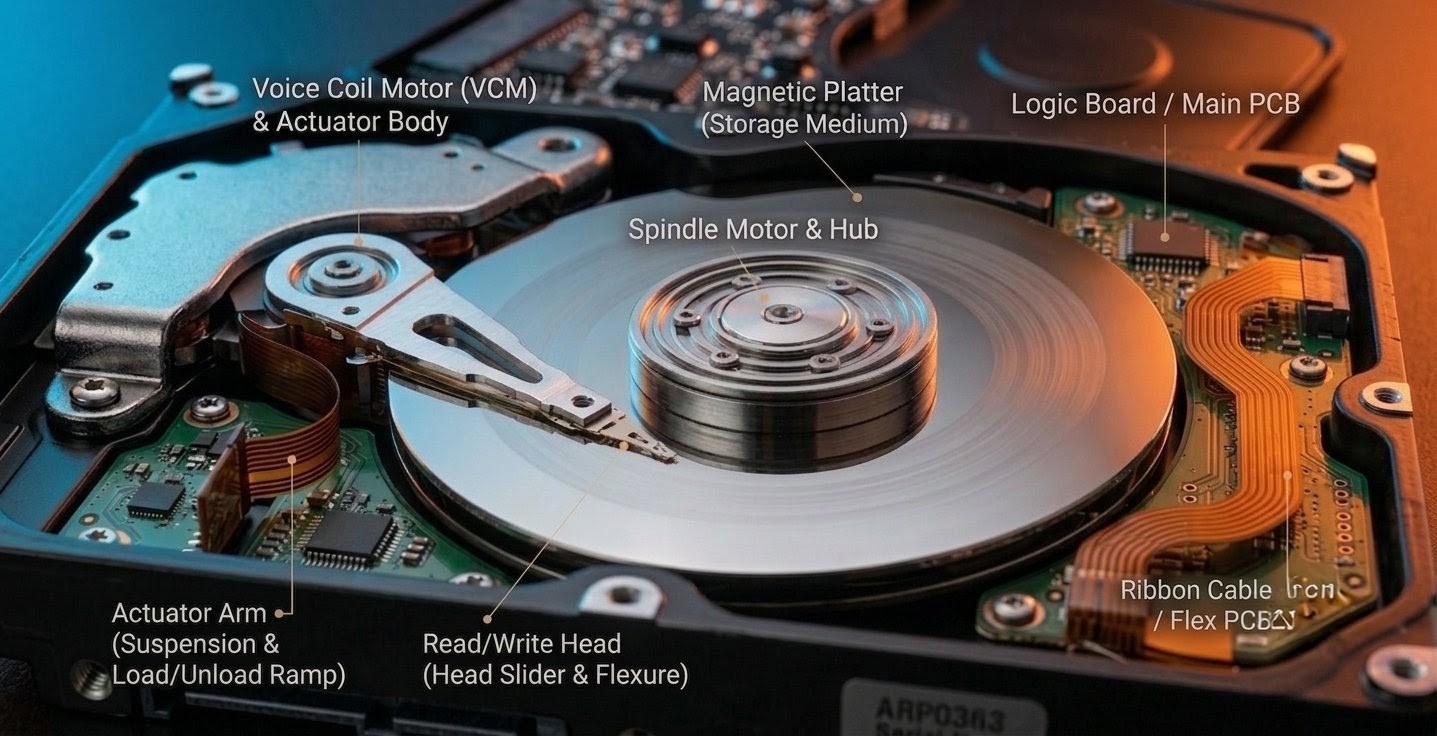
Inside an HDD, a central Spindle Motor & Hub rapidly rotates a flat Magnetic Platter, which serves as the primary storage medium. To access your data, a Voice Coil Motor (VCM) & Actuator Body swings a mechanical Actuator Arm into position. At the very tip of this arm, a microscopic Read/Write Head (Head Slider & Flexure) hovers just nanometers above the blurring surface to detect magnetic reversals. These mechanical commands are orchestrated by the Logic Board / Main PCB and transmitted via a flexible Ribbon Cable. When data is scattered randomly across the disk, waiting for these mechanical parts to physically align creates the sluggishness we all remember.
Pure Electrical Architecture (SSD)
Solid-state drives (SSDs) skip the physical journey entirely. There is no spinning disc, no actuator arm, and no moving parts to wait on. Instead, modern drives interface directly with the motherboard using high-speed connections, such as an M.2 (M-Key) PCIe Gen4 x4 NVMe Connector.
Instead, an SSD relies on purely electrical pathways, storing data in a microscopic, grid-like architecture known as NAND flash memory. Data lives inside billions of microscopic electronic cells called floating-gate transistors. By applying a precise voltage, the drive forces electrons through an insulation barrier, trapping them in a cage to register binary data (0s and 1s) at near the speed of light.
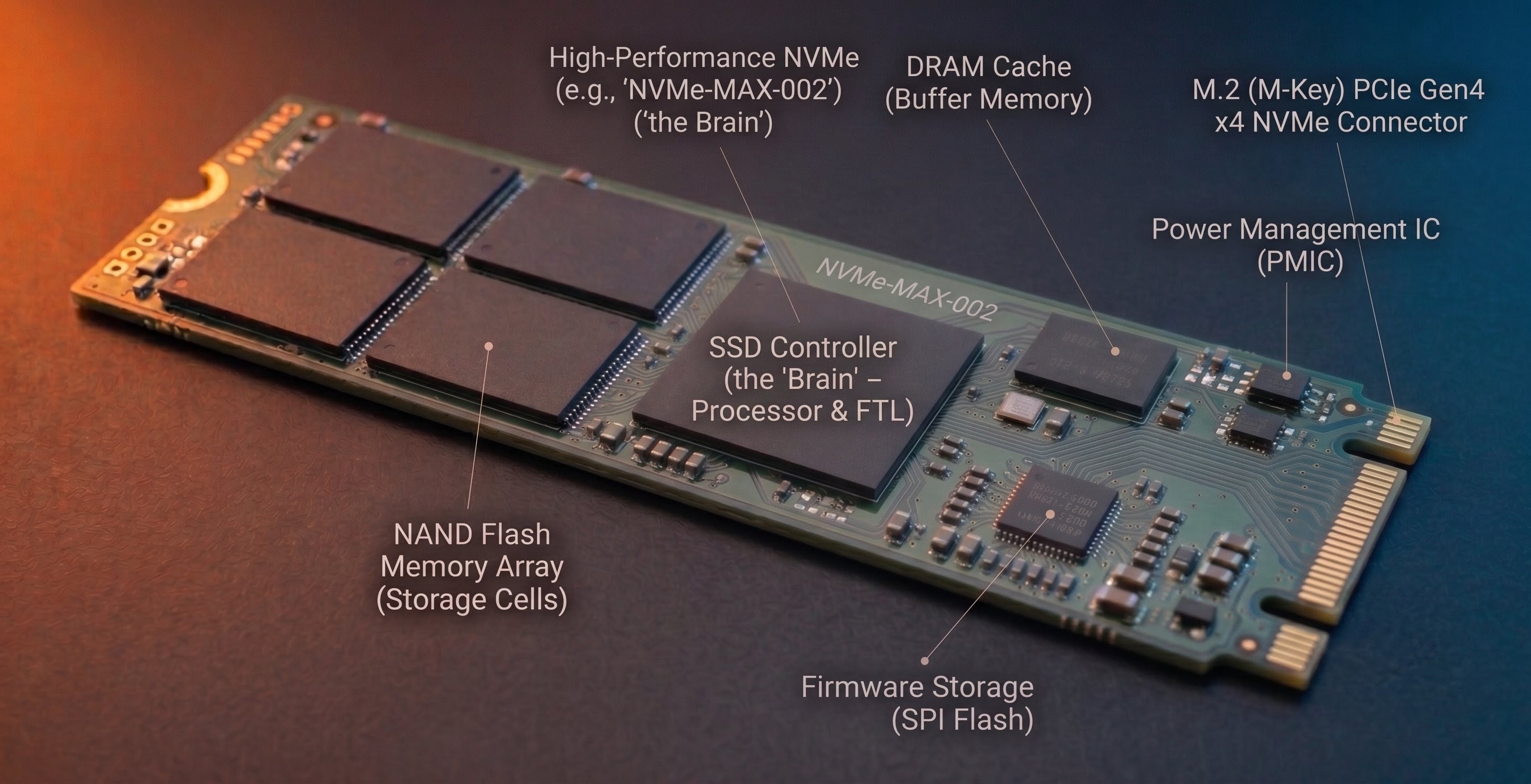
Data traffic is routed by an advanced SSD Controller, which acts as the drive's "Brain" (handling processing and FTL), often supported by a DRAM Cache for buffer memory and a Power Management IC (PMIC). The data itself is stored in a microscopic, grid-like NAND Flash Memory Array (Storage Cells). By forcing electrons through an insulation barrier, the drive traps them in a cage to register binary data (0s and 1s) at near the speed of light, dropping boot times from minutes to mere seconds. Critical drive instructions are maintained nearby in a dedicated Firmware Storage (SPI Flash) chip.
Because the SSD controller simply sends an electrical signal down this microscopic grid rather than waiting for a physical disk to spin, boot times drop from minutes to mere seconds. A basic SATA SSD moves data at roughly 500 MB/s, while newer NVMe SSDs blow past 7,000 MB/s.
The Speed Gap: The Internet Reacts
The absolute obliteration of loading times has completely changed how we interact with our machines, and the community's curated comments perfectly capture the contrast between the two storage mediums:
The Ultimate Speed Joke: Hero commenter @kxkdhhh came up with a brilliantly clever way to describe the near-instantaneous response time of an SSD, writing out a conversation where the solid-state drive answers the question before the hard drive even finishes asking it: "SSD: Yes. HDD: Do you think you are faster than me?"
Buying Back Time: The sheer quality-of-life upgrade didn't go unnoticed. @gabbarchakravorty4584 noted, "'Money can't buy you time' SSD : Hold my beer".
The Nostalgia of Waiting: For some, the extreme speed actually ruined their morning routines. @JotaroKujo_JJBA joked, "HDD gives you a chance to make a tea or coffee, so.. ☕ 🧉", while @yousefalfoqahadev added, "well atleast hard drives give you a chance to have life while its loading. you can have a shower, go on a walk, go to the gym".
The Modern Use-Case: Finally, @cyberlodaya4519 perfectly summarized why HDDs still exist today, writing, "SSD (lamborghini) vs HDD (school bus) it's a speed vs capacity and price".
While the HDD remains the king of cheap, bulk archival storage, the SSD entirely changed our philosophy on waiting. It isn't just faster; it's a completely different way of processing data.
Do you find this post helpful?