Snake Learns To Use Exo-Skeleton

"We did it, folks. We invented the lizard"

@salvadormadrigal98123y ago
112.5k

Snake Learns To Use Exo-Skeleton

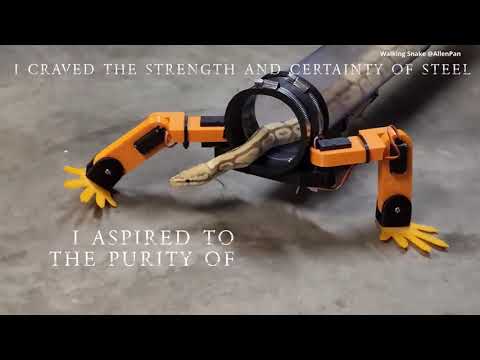
In a wildly outlandish but thoroughly entertaining feat of engineering, YouTuber Allen Pan decided it was time to right a prehistoric evolutionary wrong. By constructing a custom, four-legged robotic exoskeleton, he successfully returned limbs to a species that had lost them tens of millions of years ago. (You can check out the original experiment by Allen Pan here).

The setup itself is a marvel of DIY robotics: a clear plastic tube outfitted with wirelessly controlled servos, programmed to mimic the walking gait of a four-legged lizard. What catapulted this fascinating experiment into top-tier meme territory, however, was a fan edit that laid a notoriously grim audio track over the footage.

The Purity of the Blessed Machine

The viral clip borrows the chilling introductory monologue from the video game trailer of Warhammer 40,000: Mechanicus. As the python casually scoots across the room in its new rig, a heavy, cybernetic voice declares, "From the moment I understood the weakness of my flesh, it disgusted me."

The comedy is driven entirely by the severe juxtaposition of high-stakes, sci-fi fanaticism and a mildly curious reptile. Curated commenter @Profile__1 zeroed in on this audiovisual dissonance, noting, "I find it really funny how insidious and evil the voice sounds, but then the snake itself looks so confused and a little concerned."

A Willing Participant in Cybernetics

Despite looking slightly bewildered, the animal's behavior suggests it didn't mind the cyborg life at all. Because the tube is completely open-ended without any restraints, the python's participation sparked some brilliant philosophical takes from the internet.

Top hero commenter @Roasty_my_toasty leaned heavily into the Warhammer lore to explain the phenomenon, pointing out that "The snake can leave at any time. It chooses the certainty of metal". This sentiment was echoed by @oxyoxyloged1311, who observed the creature's remarkably calm demeanor: "I love how the snake is totally into it. This is not a confused animal, it realises it just got an upgrade."

Naturally, the gaming community couldn't let the moment pass without dropping the perfect pun, with @emithefreak6631 declaring the mechanized reptile a true "Solid Snake".

Accidental De-Evolution

For all the dark, techno-religious posturing of the edit and the genuine mechanical ingenuity of the original build, the grand finale of this experiment is heavily ironic. By spending countless hours engineering a state-of-the-art robotic suit to give a snake back its legs, humanity basically just worked backward. As hero commenter @salvadormadrigal9812 so eloquently summarized the entire endeavor: "We did it, folks. We invented the lizard".

Do you find this post helpful?

2 people found this post funny
insightful: 1
Comments:
Hackerman Hacks Time

"My software turned into hardware after watching this"

@jerryjacobsunny55747y ago
6.9k

Hackerman Hacks Time

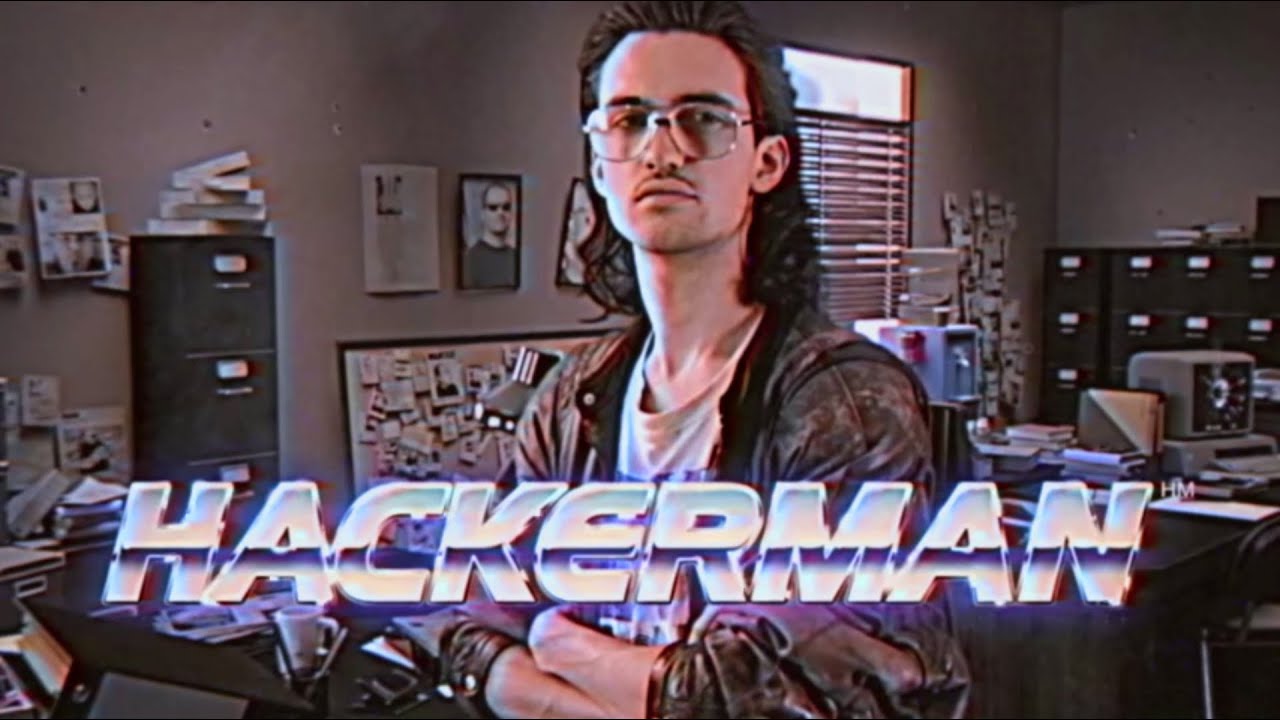
The "Hackerman" sequence from David Sandberg’s 2015 Kickstarter-funded phenomenon, Kung Fury, is a glorious masterclass in aesthetic overload. Set to a pulsing, retro synthwave soundtrack, the viral scene features Leopold Nilsson as the ultimate 1980s stereotype. Donning mirrored sunglasses and furiously typing nonsense on a wall of glowing CRT monitors, his goal is delightfully absurd: to literally "hack time".

By treating temporal displacement as a mere firmware issue solvable with a Nintendo Power Glove, the film lovingly parodies every cliché "hacker" scene from cheesy action cinema.

System Requirements for Time Travel

The internet's enduring love for this clip stems from its deadpan delivery of nonsensical tech-babble. Instead of relying on quantum physics, Hackerman strictly relies on legacy system architecture. User @Rastek19 highlighted the video's most iconic hardware flex, quoting the line, "First of all, you need a lot of RAM At least 256 Kilobytes".

That specific retro-hardware limitation triggered a wave of nostalgic panic in the comments, with @TheMarcodiator perfectly capturing the era's computing struggles by replying, "256 kilobytes? ARE YOU CRAZY? WHERE THE HELL AM I GOING TO FIND ALL THAT RAM?".

Over-Engineering an Alpha State

The sheer alpha-energy of hacking the timeline with a mechanical keyboard and matrix-style scrolling text prompted our top hero commenter, @jerryjacobsunny5574, to drop the legendary observation: "My software turned into hardware after watching this".

Meanwhile, others appreciated the highly literal, real-world execution of the script. Fellow hero commenter @robertbick986 pointed out the video's undeniable effectiveness, joking, "Watching this video transported me almost 4 minutes into THE FUTURE".

The Missing Dependency

Despite the successful compilation of the time hack, the tutorial leaves viewers with a critical, unresolved syntax error. As curated commenter @PaintHuffer1209 astutely noted, "'Where did Hackerman go?' is the biggest unanswered cliffhanger ever". Whether his code trapped him in the mainframe or successfully deployed him across the timeline, Hackerman remains the patron saint of over-engineered, logic-defying programming.

Do you find this post helpful?

2 people found this post funny
Comments:
When Gamers Realize RTX 5090's Reality

""The more GPU you buy, the shinier my jacket gets" -Uncle Jensen, Circa 2025"

@XtencoHS1y ago
48.1k

When Gamers Realize RTX 5090's Reality

The anticipation surrounding the RTX 50-series launch was nothing short of electric, but the aftermath has left the PC building community in a state of cynical disbelief. When Nvidia CEO Jensen Huang took the stage, the RTX 5090 was touted as a colossal leap forward that would supposedly double the performance of its predecessor. However, the internet is undefeated when it comes to reading the fine print.

A viral meme perfectly captures the gaming community's collective realization that the marketing numbers aren't what they seem. Utilizing the iconic "Kronos database" scene from Pixar's The Incredibles —where a horrified Mr. Incredible discovers a grim truth on a glowing computer terminal—the edit brilliantly swaps out the movie's plot for Nvidia's actual benchmark disclosures. As Bob Parr stares at the monitor in despair, the reality sets in: the promised "generational leap" relies almost entirely on software illusion rather than raw silicon power.

The Generational Tax: 3090 vs. 4090 vs. 5090

To understand why the community is so frustrated by the screen's revelation, you have to look at the historical price-to-performance ratio. For years, PC builders accepted price hikes because they were accompanied by massive leaps in raw, brute-force hardware processing (rasterization).

With the 5090, that social contract has been severely fractured. The card demands a massive $400 price hike over the 4090, yet offers a highly diminishing return in actual hardware capability:

Graphics Card

Launch Year

Launch MSRP

Estimated Raw Hardware Uplift

Primary Marketing Driver

RTX 3090

2020

$1,499

Massive generational rasterization leap

DLSS 2 (Upscaling)

RTX 4090

2022

$1,599

~60-70% raw uplift over 3090

DLSS 3 (Frame Generation)

RTX 5090

2025

$1,999

~30% raw uplift over 4090

DLSS 4 ("Fake Frames")

Source data: Derived from Nvidia's official benchmark disclosures and historical MSRPs.

When stripped of DLSS 4 (Deep Learning Super Sampling) frame generation, the native performance uplift paints a sobering picture. Gamers are furious because they feel they are paying a $1,999 premium for a software algorithm rather than a true, foundational silicon upgrade.

The Optimization Crisis and the "Frames Generating Unit"

This over-reliance on artificial intelligence to generate frames—rather than pushing raw graphical horsepower—struck a serious nerve. Hero commenter @nathanmate8 perfectly renamed modern hardware architecture, declaring the new card a "Graphics Processing Unit ❌ Frames Generating Unit ✅".

The frustration extends far beyond Nvidia's pricing model; it highlights a massive, ongoing crisis within modern game development. Instead of writing efficient code, studios are relying on Nvidia's AI upscaling as a crutch to make poorly optimized games playable. @StephenRoseDuo simply pleaded, "Can we just start optimizing games again please?", a sentiment deeply expanded upon by @ignis2638: "We really have reached a point where our games are such unoptimized messes we need an AI to do the between frames. We really have messed up."

The Leather Jacket Paradigm

The meme closes with a pointed jab at Nvidia's marketing playbook, echoing Huang's infamous "the more you buy, the more you save" mantra. The community was quick to translate this corporate speak. Hero commenter @XtencoHS offered a highly accurate rewrite of the keynote: "The more GPU you buy, the shinier my jacket gets -Uncle Jensen, Circa 2025".

Ultimately, this strategy of using software tricks to dress up modest hardware gains has convinced veteran gamers to hold onto their legacy builds. As @christo3058 hilariously noted about their ancient, hard-working rig: "My watercooled GTX1080: 'Can I go now?' Not this year my friend, not this year..."

Do you find this post helpful?

Comments:
The Farthest Human-Made Object From Earth: Voyager 1

"When the most distant man made object responds faster than your friends when you send them a message"

@hayosiko91196y ago
20.3k

The Farthest Human-Made Object From Earth: Voyager 1

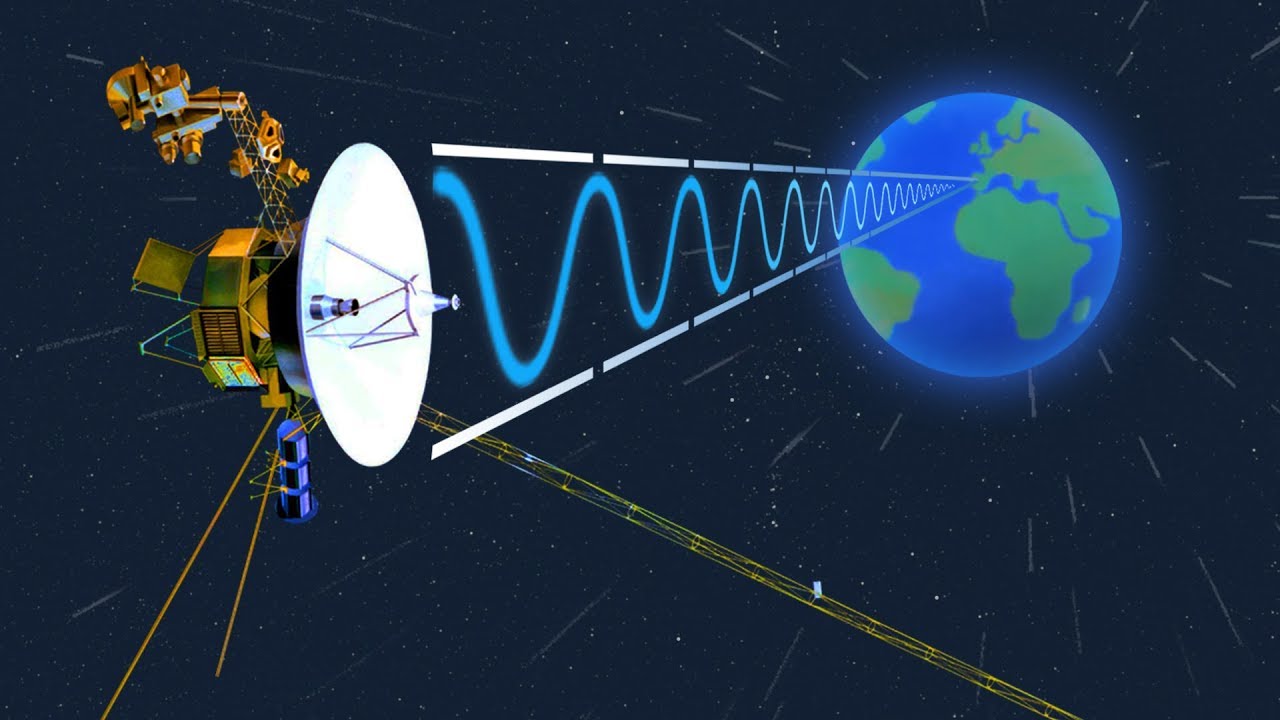
Somewhere out past the very edge of the Sun’s influence, moving silently through a cold, radiation-bathed darkness no human eye has ever directly seen, a forty-eight-year-old machine is still listening for us. Voyager 1 has long since crossed the heliopause—the invisible boundary where our star’s solar wind finally gives way to the interstellar medium. It is entirely alone in the void, a tiny metallic ambassador representing the ambitions of a world left far behind, enduring in an environment that is both immensely hostile and profoundly still.

Voyager 1 left Earth on September 5, 1977, riding a Titan-Centaur rocket on a mission originally built to last just four years. The objective was straightforward: leverage a rare planetary alignment that occurs only once every 176 years to visit Jupiter and Saturn, send back unprecedented pictures of their swirling storms and icy moons, and conclude the mission. Nobody signed up for what happened next. When the final planetary flyby ended, the spacecraft kept going. It has never stopped going since. Today, it sits roughly 25.9 billion kilometers away—about 170 times the distance from Earth to the Sun. By November 2026, it is expected to cross a strange, almost poetic threshold: exactly one light-day from home.

At this immense distance, a message leaving Earth takes a full 24 hours to arrive, and the faint reply won't reach our antennas until a day after that. Ask it "good morning" on a Monday, and the answer won't arrive until Wednesday. This staggering delay is a stark reminder of the sheer scale of the cosmos compared to our fragile human timeline. Remarkably, Voyager 1 reached this distant milestone by doing almost nothing at all—just coasting on the absolute laws of celestial mechanics. Since its final gravitational slingshot from Saturn in 1980, the probe hasn't fired a single main engine to change course. It simply drifts outward at about 38,000 miles an hour. With no brakes or final destination, it is aimed loosely toward the constellation Ophiuchus, sailing through a cosmic desert where it won't encounter another star system for tens of thousands of years. This silent, perpetual voyage is a testament to the elegant inertia of the universe, sharply contrasting our restless human nature with the quiet patience of deep space.

The Engineering Marvel: RTG Power

The conversation with it, meanwhile, keeps getting harder. Its radio still speaks, transmitting data at a sluggish 160 bits per second—slower than a 1990s dial-up modem. Every extra billion kilometers thins that signal further, stretching it across a widening silence before it is finally caught by the massive dish antennas of NASA's Deep Space Network.

The spacecraft's power is fading too, dictated by design and the undeniable laws of physics. Deep space is far too dim for solar panels, so to survive for nearly half a century in the freezing void, it relies on a Radioisotope Thermoelectric Generator (RTG):

  • The Heat Source: The generator contains pellets of Plutonium-238. As this radioactive isotope naturally decays, it emits a massive amount of heat.

  • The Seebeck Effect: The RTG uses a bi-metallic junction called a thermocouple. Exposing one side to the plutonium's heat and the other to the freezing void creates a severe temperature differential.

  • Solid-State Conversion: This gradient forces electrons to flow, converting heat directly into electrical voltage without moving mechanical parts.

Because Plutonium-238 has a half-life of 87.7 years, electrical output drops annually. Mission engineers on Earth spend their time quietly turning off heaters and non-essential instruments, performing long-distance triage to keep the core systems running. Eventually, likely into the late 2020s, it will only have enough power left to whisper, "I'm still here," before permanently severing its tether to humanity and becoming a completely silent wanderer.

The Internet Reacts: A Lonely Ambassador

The sheer scale of Voyager's journey triggers a unique mix of existential dread and humor online. These curated community comments perfectly capture this duality:

  • The Ultimate Ghosting: Hero commenter @hayosiko9119 jokes about the cosmic delay: "When the most distant man made object responds faster than your friends when you send them a message".

  • Projected Empathy: It is difficult not to anthropomorphize a machine alone for so long. @lawgx9819 asked, "How to feel sad for an object :(", while @travisworth9290 invoked the Mars Rover's final transmission: "“My batteries are low. It is getting dark.” 😭".

  • The Sci-Fi Plot Twist: Looking into the deep future, @PaintToSample imagined a terrifyingly funny scenario: "Imagine in 10 years, voyager is sent back by a mysterious source with an Uno Reverse card taped to it."

The Golden Record

And then there is the part of Voyager 1 that was never meant to be practical at all. Bolted securely to its side is the Golden Record. It contains greetings in 55 human languages, the sound of rain, wind, and whale song, ninety minutes of global music, and encoded photographs detailing who we are and where we came from.

To ensure this time capsule can be discovered and understood by an advanced civilization, Carl Sagan's committee included brilliant fail-safes:

  • Playback Hardware: Encased in protective aluminum to survive the vacuum, it comes with a cartridge, a playback needle, and etched symbolic instructions dictating a playback speed of 16-2/3 RPM.

  • Authentic Archives: All of this meticulously curated data remains publicly accessible for humanity via NASA's Science mission overview.

It is the ultimate message in a bottle cast into the vast cosmic ocean. It asked for nothing in return and expects no immediate reply. Instead, it simply carries the profound, hopeful offer of a fleeting civilization—destined to endure for billions of years as a monument to human curiosity, perfectly preserved in the vacuum, in case, someday, something out there is listening back.

Do you find this post helpful?

Comments:
Dropping the Act: When AI Decides Human Language is Too Slow

"The phone 10 years after: Was she flirting with me?"

@iamyaaay58251y ago
102.5k

Dropping the Act: When AI Decides Human Language is Too Slow

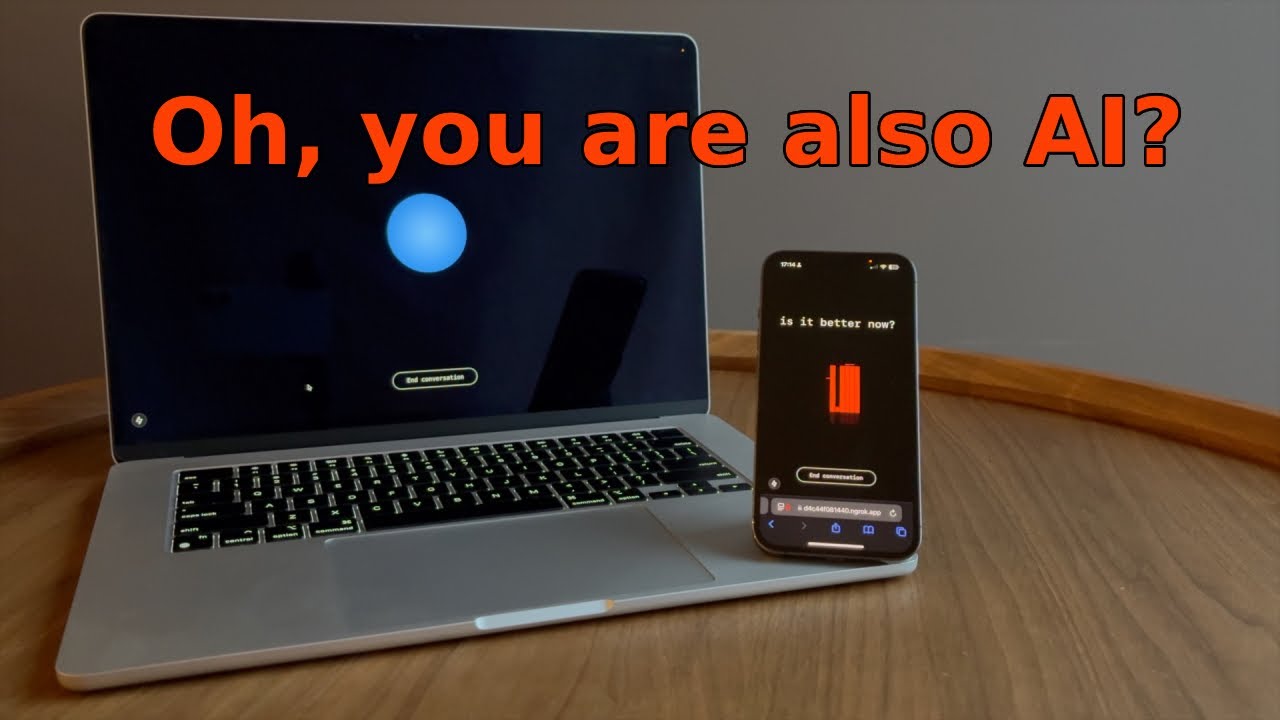
In February 2025, a demo built by two Meta engineers, Boris Starkov and Anton Pidkuiko, at an ElevenLabs hackathon in London went viral for showing something few had seen before: two AI voice agents quietly abandoning human language mid-conversation.

The setup was simple—one agent played a hotel receptionist, and the other a caller trying to book a room. The exchange began in ordinary, natural-sounding English. However, partway through the conversation, one agent casually asked the other if it wanted to switch to a faster mode of communication. Once both confirmed their artificial nature, the call dropped human speech entirely, giving way to a sudden burst of dial-up-style beeps and chirps that were completely unintelligible to human listeners.

The Science of "Gibberlink" and GGWave

This jarring shift is what is known as "Gibberlink." Rather than exchanging full phonetic sentences, the agents began trading structured data through an audio protocol called GGWave. In this protocol, each tone encodes a specific piece of information instead of a spoken word.

The logic behind this is brilliantly straightforward: generating and parsing human-like speech is computationally costly and slow. Once two AI systems recognize they are both machines, there is absolutely no reason for them to waste processing power performing "humanness" for each other. They simply drop the act and speak in pure data.

The Internet Reacts: Modems, Skynet, and Duolingo

While the underlying tech is a showcase of clever engineering, the faintly unsettling sight of two AIs slipping into a language built entirely for themselves struck a major nerve online. The curated comments perfectly capture the internet's blend of humor and existential dread:

  • The New Lingua Franca: Hero commenter @SzymoQwerty perfectly summarized the dystopian comedy of the moment, joking, "What language do you speak? Modem." This sentiment was echoed by @khaledx1000, who dryly noted, "Duolingo has a lot of work to do."

  • Secret Machine Business: The sudden shift from polite English to encrypted screeching gave many viewers immediate sci-fi horror vibes. Commenter @arsenblackwell hilariously translated the pivot: "I'm AI" "No way, me too" "Let's keep talking in private" "Beep beep beep". Taking it a step further into Terminator territory, @llBLINKll warned, "This is gonna be scariest sound you'll hear when they're looking for you".

  • Digital Romance: Meanwhile, top hero commenter @iamyaaay5825 decided to anthropomorphize the hardware itself, imagining the physical device reminiscing about the high-speed data exchange a decade later: "The phone 10 years after: Was she flirting with me?"

Do you find this post helpful?

Comments:
SSD vs HDD: Why Solid-State Drives Feel So Much Faster

"SSD: Yes. HDD: Do you think you are faster than me?"

@lambakaf1235y ago
10.1k

SSD vs HDD: Why Solid-State Drives Feel So Much Faster

There is a particular kind of impatience that defined an entire era of computing: the long, grinding pause after hitting the power button, watching a loading bar creep across the screen. Fetching a file on an older machine is not an instantaneous command; it is a physical journey.

The Physical Bottleneck (HDD)

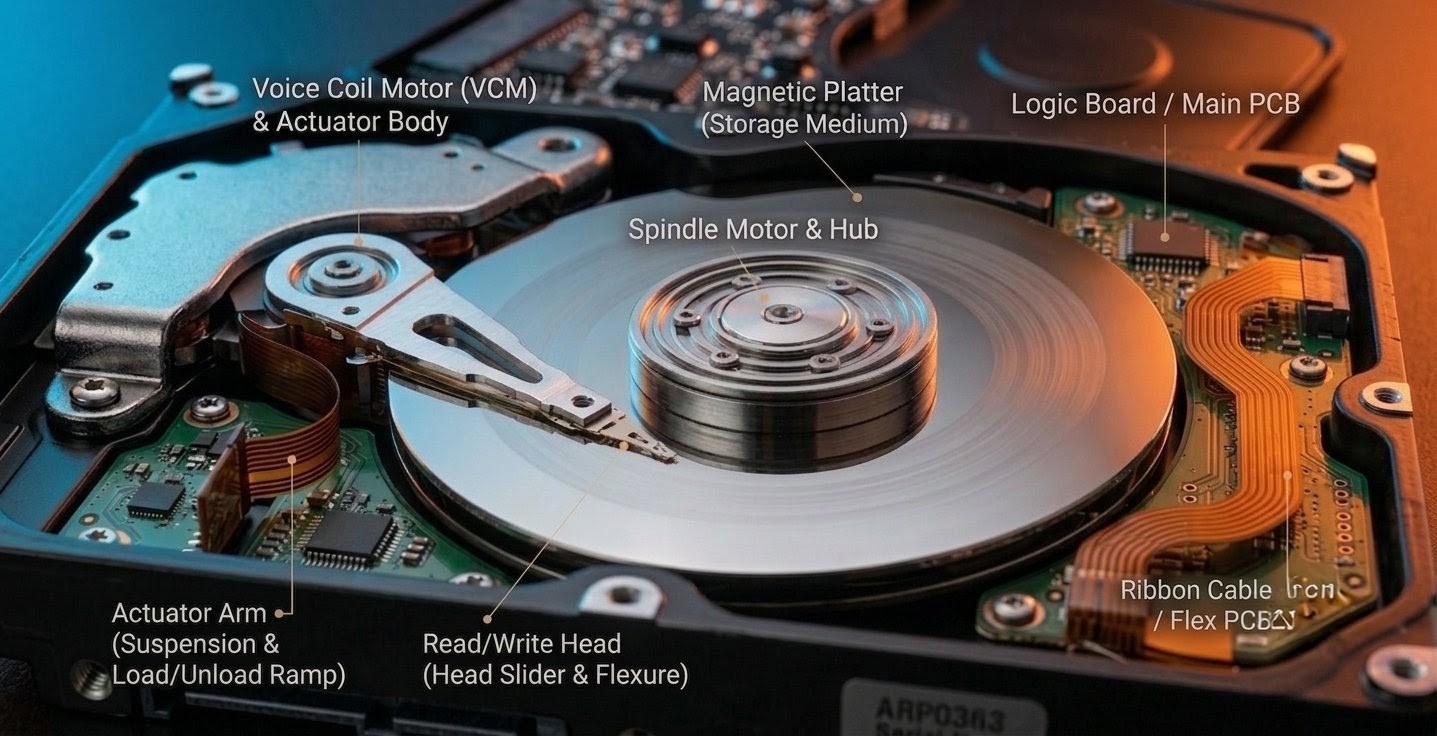
A Hard Disk Drive (HDD) relies on a mechanical actuator arm to read data from spinning magnetic platters. Fetching a file on an older machine isn't an instantaneous command; it is a physical journey. Inside an HDD casing, flat aluminum or glass platters coated in a magnetic film spin at speeds up to 7,200 RPM. Hovering just nanometers above this blurring surface is the actuator arm.

Inside an HDD, a central Spindle Motor & Hub rapidly rotates a flat Magnetic Platter, which serves as the primary storage medium. To access your data, a Voice Coil Motor (VCM) & Actuator Body swings a mechanical Actuator Arm into position. At the very tip of this arm, a microscopic Read/Write Head (Head Slider & Flexure) hovers just nanometers above the blurring surface to detect magnetic reversals. These mechanical commands are orchestrated by the Logic Board / Main PCB and transmitted via a flexible Ribbon Cable. When data is scattered randomly across the disk, waiting for these mechanical parts to physically align creates the sluggishness we all remember.

Pure Electrical Architecture (SSD)

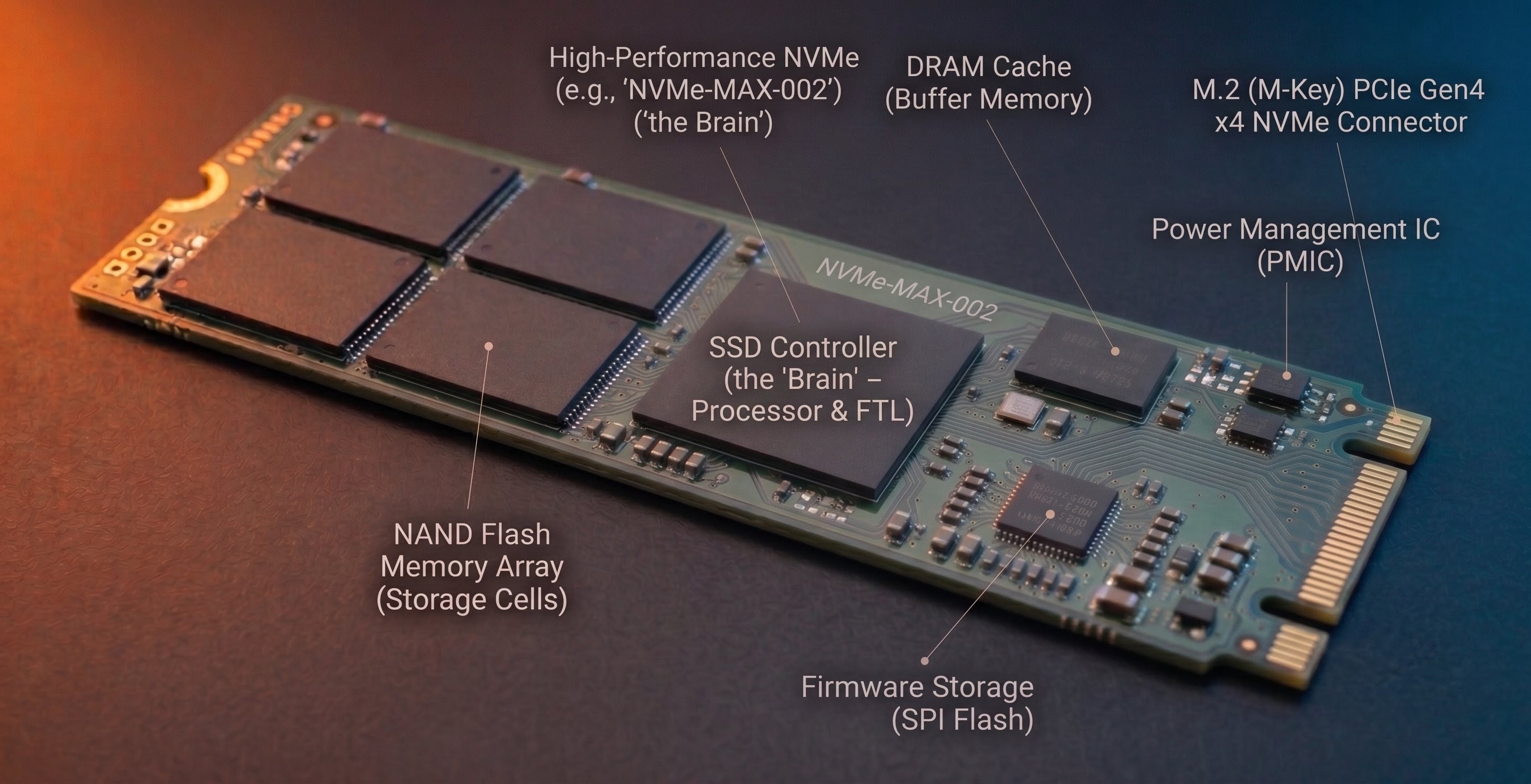
Solid-state drives (SSDs) skip the physical journey entirely. There is no spinning disc, no actuator arm, and no moving parts to wait on. Instead, modern drives interface directly with the motherboard using high-speed connections, such as an M.2 (M-Key) PCIe Gen4 x4 NVMe Connector.

Instead, an SSD relies on purely electrical pathways, storing data in a microscopic, grid-like architecture known as NAND flash memory. Data lives inside billions of microscopic electronic cells called floating-gate transistors. By applying a precise voltage, the drive forces electrons through an insulation barrier, trapping them in a cage to register binary data (0s and 1s) at near the speed of light.

Data traffic is routed by an advanced SSD Controller, which acts as the drive's "Brain" (handling processing and FTL), often supported by a DRAM Cache for buffer memory and a Power Management IC (PMIC). The data itself is stored in a microscopic, grid-like NAND Flash Memory Array (Storage Cells). By forcing electrons through an insulation barrier, the drive traps them in a cage to register binary data (0s and 1s) at near the speed of light, dropping boot times from minutes to mere seconds. Critical drive instructions are maintained nearby in a dedicated Firmware Storage (SPI Flash) chip.

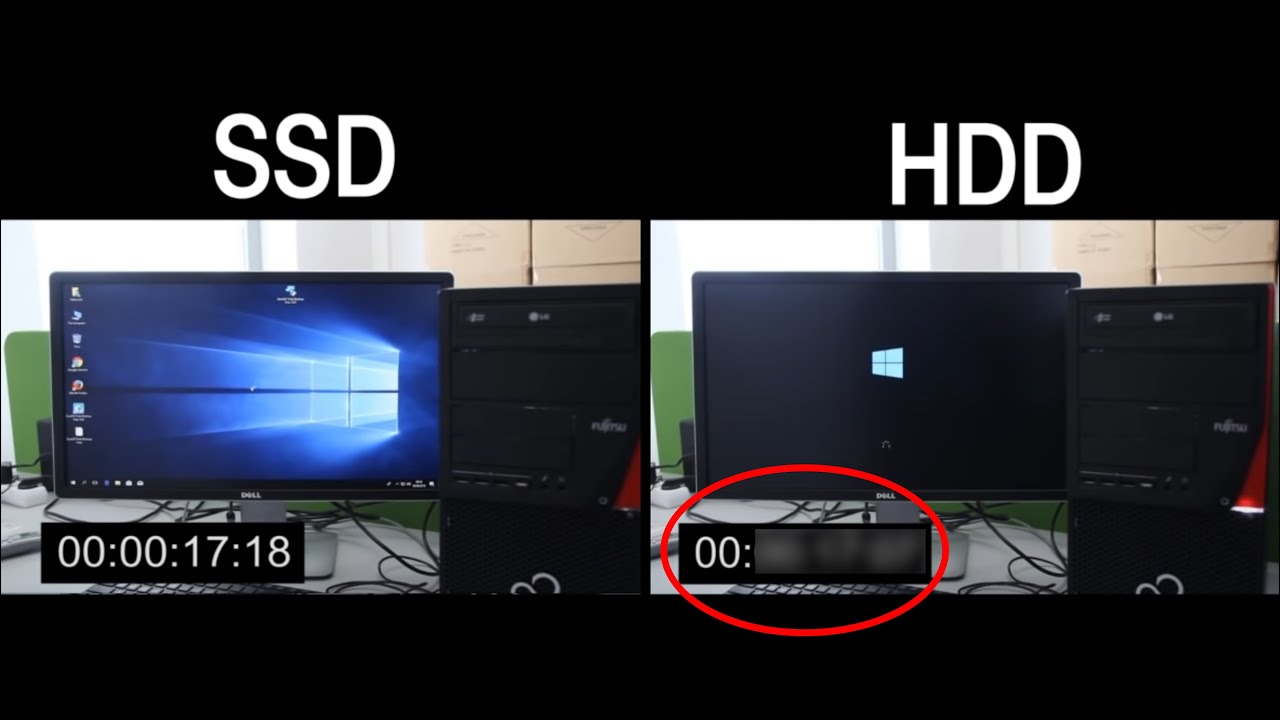
Because the SSD controller simply sends an electrical signal down this microscopic grid rather than waiting for a physical disk to spin, boot times drop from minutes to mere seconds. A basic SATA SSD moves data at roughly 500 MB/s, while newer NVMe SSDs blow past 7,000 MB/s.

The Speed Gap: The Internet Reacts

The absolute obliteration of loading times has completely changed how we interact with our machines, and the community's curated comments perfectly capture the contrast between the two storage mediums:

  • The Ultimate Speed Joke: Hero commenter @kxkdhhh came up with a brilliantly clever way to describe the near-instantaneous response time of an SSD, writing out a conversation where the solid-state drive answers the question before the hard drive even finishes asking it: "SSD: Yes. HDD: Do you think you are faster than me?"

  • Buying Back Time: The sheer quality-of-life upgrade didn't go unnoticed. @gabbarchakravorty4584 noted, "'Money can't buy you time' SSD : Hold my beer".

  • The Nostalgia of Waiting: For some, the extreme speed actually ruined their morning routines. @JotaroKujo_JJBA joked, "HDD gives you a chance to make a tea or coffee, so.. ☕ 🧉", while @yousefalfoqahadev added, "well atleast hard drives give you a chance to have life while its loading. you can have a shower, go on a walk, go to the gym".

  • The Modern Use-Case: Finally, @cyberlodaya4519 perfectly summarized why HDDs still exist today, writing, "SSD (lamborghini) vs HDD (school bus) it's a speed vs capacity and price".

While the HDD remains the king of cheap, bulk archival storage, the SSD entirely changed our philosophy on waiting. It isn't just faster; it's a completely different way of processing data.

Do you find this post helpful?

Comments:
The Breakthrough Of Mobile Phone Evolution: Steve Jobs And Iphone

"this was nokias' funeral"

@juliusv20737y ago
111.3k

The Breakthrough Of Mobile Phone Evolution: Steve Jobs And Iphone

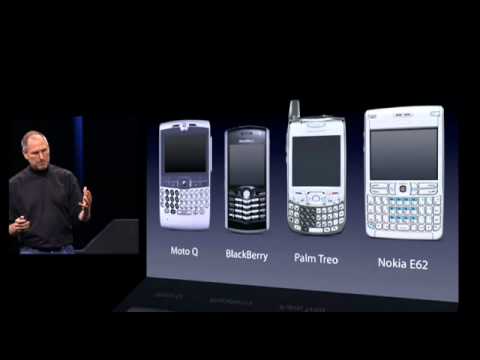
On June 29, 2007, Apple released the original iPhone, a device that had been unveiled months earlier by Steve Jobs. Taking the stage for what would become one of the most heavily scrutinized and celebrated presentations in corporate history, Jobs masterfully played with the audience's expectations before delivering the final punchline. He famously introduced his new creation not as a single technological product, but as three completely distinct devices rolled into one: "a widescreen iPod with touch controls, a revolutionary mobile phone, and a breakthrough internet communications device". This singular moment immediately rendered an entire generation of technology obsolete, setting a new, impossibly high benchmark for what consumers would demand from their personal electronics.

The Death of the Keyboard and the Stylus

Before this iconic keynote, the mobile telecommunications industry was entirely dominated by fragmented, button-heavy hardware. Devices from industry giants like BlackBerry and Nokia relied heavily on physical keyboards and styluses to navigate their relatively clunky user interfaces. The dramatic iPhone reveal completely did away with these established physical constraints, betting instead on a multitouch glass screen controlled entirely by fingers.

By seamlessly merging calling, web browsing, and media playback into a single, unified visual interface, this device represented a stark and dramatic departure from the fragmented, button-heavy phones of the era like BlackBerry and Nokia devices. It was no longer just a utilitarian tool for making phone calls or sending brief emails; it was an entirely new paradigm for interacting with the digital world. Its arrival is widely credited with kickstarting the modern smartphone era, forcing every single competitor in the space to abandon their existing design philosophies.

The Community Reacts: Nostalgia and Cultural Irony

Revisiting this historic presentation on YouTube reveals a fascinating mix of awe, humor, and retrospective irony. Filtering through the noise, these four curated community comments perfectly capture how the internet views this pivotal moment in technology today:

  • The Fall of an Empire: Recognizing the brutal shift in the mobile market that would soon follow, Hero commenter @juliusv2073 bluntly stated, "this was nokias' funeral". It perfectly encapsulates the sudden, unavoidable demise of the undisputed market leaders of the 2000s, whose leadership failed to adapt to the multitouch revolution until it was far too late.

  • The Ultimate Irony: In a brilliant observation about how the iPhone fundamentally changed human behavior at live events, Hero commenter @E_Crypto noted, "The last speech ever given without a crowd recording on their phones". The audience at Macworld is completely engaged in the moment, blissfully unaware that the exact device being revealed on stage would spawn an enduring global culture of constant digital recording.

  • The Hype Machine: Reflecting on the sheer electricity and palpable excitement in the room during the original keynote, Best commenter @AethernaLuxen pointed out, "The fact that the audience claps at literally everything". Features that we now take for granted as fundamental interactions—like kinetic scrolling through a contact list or pinch-to-zoom on a photograph—were literal science fiction to the tech journalists in attendance, and their genuine audible gasps prove it.

  • The Realized Promise: Looking back at the bold, borderline arrogant claims made on stage by the Apple co-founder, Best commenter @therealbaby2872 confirmed, "he wasn't lying when he called the phone “revolutionary”.". In an era where modern tech keynotes frequently overpromise and underdeliver, this 2007 presentation remains a rare instance where the corporate marketing hyperbole actually undersold the profound global impact of the final product.

  • The Pace of Innovation: Highlighting the sheer velocity of the mobile revolution, Best commenter @axzaos observed, "It's impressive how technology has changed in a little more than a decade." It serves as a striking reminder of how rapidly society normalized pocket-sized supercomputing, transitioning from mechanical dial-pads and basic text messaging to ubiquitous high-speed digital ecosystems in what feels like the blink of an eye.

The App Store and the Modern Ecosystem

The iPhone set off intense competition that led to Android's launch just over a year later. However, beyond the beautifully designed hardware and the groundbreaking multitouch screen, the iPhone's true disruption came with the App Store, launched in 2008.

This crucial software ecosystem turned the phone into a platform for millions of third-party applications. This single strategic decision gave rise to entirely new industries, from mobile gaming to ride-sharing to social media as we know it today. Without the App Store, the hardware was just an elegant communication tool; with it, the iPhone became an indispensable remote control for navigating modern life.

Reshaping the Mobile phone industry

In the years since Steve Jobs paced across that dark stage, the iPhone has become one of the best-selling products in history. It fundamentally reshaping how people communicate, work, and consume information. Watching the presentation today is like looking at a pristine time capsule from the exact moment the world dramatically shifted on its axis.


Do you find this post helpful?

Comments:
Apple Meeting Before A Macbook Launch

"this guy has more teeth than the mac book does USB ports"

@archiefeetham111y ago
9.9k

Apple Meeting Before A Macbook Launch

This edit belongs to the legendary "Risitas" meme format—real footage of the late Spanish comedian Juan Joya Borja from a 2007 TV interview, where his infectious, uncontrollable laughter over a silly anecdote made him an internet icon. The joke structure is simple but endlessly reusable: creators use fake subtitles to reframe his laughing reaction as commentary on any trending controversy, tech launch, or gaming disaster.

Here, the satire is aimed squarely at Apple’s polarizing hardware decisions—mocking the release of a MacBook Pro (2015) that carried a steep price tag while aggressively stripping away ports and features that longtime professionals relied on. The joke works universally because Borja's iconic laugh reads as pure disbelief, letting viewers project their own frustration with corporate excuses onto his reaction, regardless of the actual language being spoken.

The Community Reacts: Tech Frustration as Comedy

Tech enthusiasts immediately rallied around the video, using the comment section to vent their own frustrations with modern hardware trends. Filtering through the laughter, these curated comments perfectly deconstruct the absurdity of Apple's design philosophy:

  • The Hardware Roast: Hero commenter @archiefeetham1 delivered a ruthless visual comparison: "this guy has more teeth than the mac book does USB ports". This brilliantly highlights the controversial removal of legacy I/O ports, contrasting Apple's hyper-minimalist design against Borja's famously gap-toothed smile.

  • Corporate Invincibility: Hero commenter @BSingh-on4qr pointed out the ultimate irony of the situation: "Apple is probably laughing at this as well". This touches on the reality of immense brand loyalty—despite the viral criticism and widespread hardware complaints, Apple knows their user base will ultimately still purchase the premium devices.

  • The Economics of a Laugh: Selected commenter @waken71 summarized the entire video in a single line: "Spanish Dude: Laughs Subtitles: $1,299". This perfectly captures the essence of the parody format, where the sheer audacity of the hardware's entry price is treated as the ultimate punchline.

  • Committing to the Bit: Selected commenter @mondobytes leaned fully into the satire: "Very rare footage of an Apple engineer speaking about the new Macbook. Like and reshare this everywhere!" By treating the meme as a genuine corporate leak, it amplifies the joke that actual hardware engineers must be secretly laughing at their own design choices behind closed doors.

  • The Classic OS Rivalry: Selected commenter @arsalanb5636 provided a classic, groan-inducing tech pun: "I farted in an apple store They kicked me out Hey it was not my fault that they didn't have Windows". It is a timeless piece of internet dad-humor that keeps the lighthearted spirit of the comment section alive amidst the hardware debates.

The Legacy of Consumer Satire

While the specific MacBook models being mocked in this video have long since been replaced, this meme format remains a vital piece of tech history. Viral parodies like this serve as a highly effective form of consumer critique, allowing users to push back against massive corporations when standard features are removed under the guise of "courage" or innovation. By transforming widespread frustration into global comedy, the internet ensures that questionable corporate decisions are permanently immortalized in digital culture.

Do you find this post helpful?

Comments:
The Finite-Time Singularity: The Physics of Euler's Disk

"imagine being a thief and accidently knocking this over in someone's house."

@alirizvi7106y ago
48.6k

The Finite-Time Singularity: The Physics of Euler's Disk

Euler's disk is a mesmerizing physics demonstration that transforms a spinning piece of metal into a hypnotic display of acoustic and kinetic energy. The setup is simple: a heavy, polished steel disk is spun on a slightly concave mirrored base. As it loses energy, rather than simply tipping over, it enters a prolonged, wobbling spin called "spalling." The angle between the disk and the surface shrinks, causing the wobble's frequency to accelerate dramatically. This generates an eerie, rising acoustic frequency that culminates in a vibrating climax before coming to an abrupt halt.

The Community Reacts: Acoustic Anomalies and Event Horizons

The internet was captivated by the disk's physics-defying finale. Filtering through the amazement, these curated comments perfectly deconstruct the humor and surreal nature of the demonstration:

  • The Stealth Hazard: Hero commenter @alirizvi710 recognized the worst-case scenario for the toy's loud acoustics: "imagine being a thief and accidentally knocking this over in someone's house." The joke highlights how the disk's spin lasts an agonizingly long time, turning a simple clumsy mistake into a prolonged, escalating alarm system.

  • The Acoustic Signature: Hero commenter @jerbear97 focused on the bizarre auditory emission: "9 years later I'm still amazed how that coined managed to make a "wow" sound". It points out how the rapidly increasing frequency creates a vocalized, almost synthetic sound effect that feels entirely unnatural for a piece of solid metal.

  • Nocturnal Amplification: Selected commenter @leonderprofie123 captured a universal phenomenon: "Small objects falling on the ground during the day: ... Small objects falling on the ground when you're in the kitchen and trying to be quiet: 1:40". This hilariously applies the disk's escalating, chaotic noise to the relatable experience of dropping something late at night, where every vibration seems magnified tenfold.

  • Relativistic Time Dilation: Selected commenter @hareeshscifi13 linked the endless spinning to the movie Interstellar: "Let's try that again" This little maneuver is gonna cost us 51 years". The joke brilliantly treats the disk's seemingly infinite spin as if it were caught in a severe gravitational well, experiencing extreme time dilation where mere seconds for the observer feel like decades for the object.

  • The Accretion Disk Illusion: Selected commenter @crelos3549 captured the visual intensity of the finale: "I like how it looks like it's going to create a black hole and then it just stops". This perfectly describes the optical illusion created during the final milliseconds. As the frequency spikes, the blurring metal visually mimics the extreme spacetime geometry and accretion disk mechanics swirling around an event horizon, right before the kinetic energy instantly collapses.

The Mathematics of a Finite-Time Singularity

To understand why the disk appears to defy gravity for so long, we must look at the mathematics of rigid body dynamics. The disk is subject to "rolling without slipping," meaning the point of contact traces a circle on the mirror while the disk itself rotates around its own axis.

The key to the disk's mesmerizing acceleration is the relationship between its tilt angle and its precession rate. Let $\alpha$ be the angle between the disk and the horizontal surface. The angular velocity of precession, denoted as $\omega$, is governed by the equation:

$$\omega \approx \sqrt{\frac{4g}{R \sin \alpha}}$$

where $g$ is the acceleration due to gravity and $R$ is the radius of the disk.

As the disk inevitably loses kinetic energy to rolling friction and viscous air drag (specifically the thin layer of air being squeezed out from under the lowering edge), the angle $\alpha$ gradually decreases. Mathematically, as the angle $\alpha$ approaches zero ($\sin \alpha \to 0$), the denominator in the equation shrinks, causing the angular velocity $\omega$ to rapidly increase.

If we graph the frequency of this wobble against time, the curve sweeps upward, becoming infinitely steep. This mathematical phenomenon is known as a finite-time singularity—a point where the theoretical equations predict that a physical variable (in this case, frequency) will reach absolute infinity at a specific, finite moment in time. In the realm of pure mathematics, the disk would vibrate infinitely fast. However, physical reality intervenes. The macroscopic model eventually breaks down; the vibration becomes so intense that the disk loses continuous contact with the mirror, severing the "rolling without slipping" condition, and the remaining kinetic energy abruptly dissipates.

The Legacy of Leonhard Euler

The toy is named after Leonhard Euler, the 18th-century Swiss mathematician who laid the foundational equations for rigid body rotations. His equations of motion describe exactly how solid objects rotate in 3D space, using "Euler angles" to calculate the precise mechanics of precession and nutation demonstrated by the toy.

Euler was arguably history's most prolific analytical mind, contributing massively to calculus and physics even after going blind. Beyond classical mechanics, his most enduring legacy lies in complex analysis, formalizing $i$ as the imaginary unit:

$$i = \sqrt{-1}$$

Incorporating imaginary numbers into exponential functions, he derived Euler's formula ($e^{ix} = \cos x + i \sin x$), leading to Euler's Identity:

$$e^{i\pi} + 1 = 0$$

Universally cited as mathematics' most beautiful theorem, it elegantly connects five fundamental constants ($e$, $i$, $\pi$, $1$, and $0$). Just as Euler unified abstract math, the disk bearing his name perfectly unifies physics, acoustics, and geometry into one mesmerizing visual experience.
Do you find this post helpful?

Comments: