"When the most distant man made object responds faster than your friends when you send them a message"
The Farthest Human-Made Object From Earth: Voyager 1
Somewhere out past the very edge of the Sun’s influence, moving silently through a cold, radiation-bathed darkness no human eye has ever directly seen, a forty-eight-year-old machine is still listening for us. Voyager 1 has long since crossed the heliopause—the invisible boundary where our star’s solar wind finally gives way to the interstellar medium. It is entirely alone in the void, a tiny metallic ambassador representing the ambitions of a world left far behind, enduring in an environment that is both immensely hostile and profoundly still.
Voyager 1 left Earth on September 5, 1977, riding a Titan-Centaur rocket on a mission originally built to last just four years. The objective was straightforward: leverage a rare planetary alignment that occurs only once every 176 years to visit Jupiter and Saturn, send back unprecedented pictures of their swirling storms and icy moons, and conclude the mission. Nobody signed up for what happened next. When the final planetary flyby ended, the spacecraft kept going. It has never stopped going since. Today, it sits roughly 25.9 billion kilometers away—about 170 times the distance from Earth to the Sun. By November 2026, it is expected to cross a strange, almost poetic threshold: exactly one light-day from home.
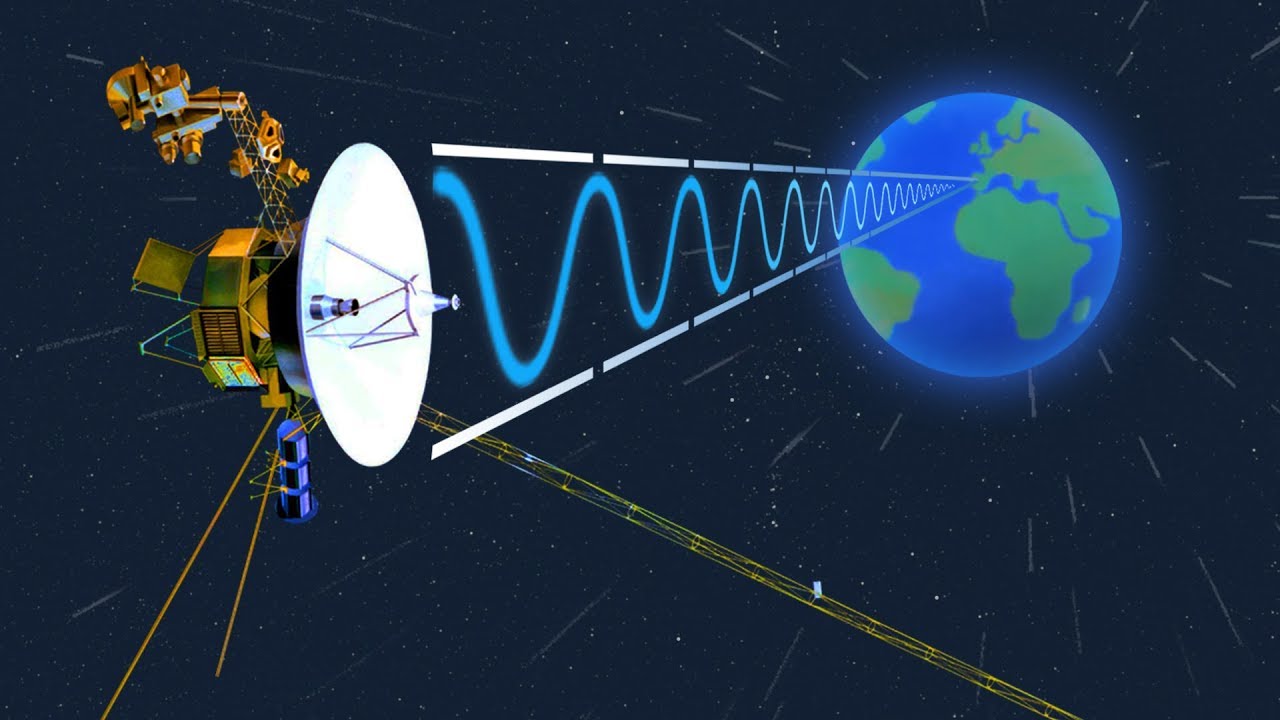
At this immense distance, a message leaving Earth takes a full 24 hours to arrive, and the faint reply won't reach our antennas until a day after that. Ask it "good morning" on a Monday, and the answer won't arrive until Wednesday. This staggering delay is a stark reminder of the sheer scale of the cosmos compared to our fragile human timeline. Remarkably, Voyager 1 reached this distant milestone by doing almost nothing at all—just coasting on the absolute laws of celestial mechanics. Since its final gravitational slingshot from Saturn in 1980, the probe hasn't fired a single main engine to change course. It simply drifts outward at about 38,000 miles an hour. With no brakes or final destination, it is aimed loosely toward the constellation Ophiuchus, sailing through a cosmic desert where it won't encounter another star system for tens of thousands of years. This silent, perpetual voyage is a testament to the elegant inertia of the universe, sharply contrasting our restless human nature with the quiet patience of deep space.
The Engineering Marvel: RTG Power
The conversation with it, meanwhile, keeps getting harder. Its radio still speaks, transmitting data at a sluggish 160 bits per second—slower than a 1990s dial-up modem. Every extra billion kilometers thins that signal further, stretching it across a widening silence before it is finally caught by the massive dish antennas of NASA's Deep Space Network.
The spacecraft's power is fading too, dictated by design and the undeniable laws of physics. Deep space is far too dim for solar panels, so to survive for nearly half a century in the freezing void, it relies on a Radioisotope Thermoelectric Generator (RTG):
The Heat Source: The generator contains pellets of Plutonium-238. As this radioactive isotope naturally decays, it emits a massive amount of heat.
The Seebeck Effect: The RTG uses a bi-metallic junction called a thermocouple. Exposing one side to the plutonium's heat and the other to the freezing void creates a severe temperature differential.
Solid-State Conversion: This gradient forces electrons to flow, converting heat directly into electrical voltage without moving mechanical parts.
Because Plutonium-238 has a half-life of 87.7 years, electrical output drops annually. Mission engineers on Earth spend their time quietly turning off heaters and non-essential instruments, performing long-distance triage to keep the core systems running. Eventually, likely into the late 2020s, it will only have enough power left to whisper, "I'm still here," before permanently severing its tether to humanity and becoming a completely silent wanderer.
The Internet Reacts: A Lonely Ambassador
The sheer scale of Voyager's journey triggers a unique mix of existential dread and humor online. These curated community comments perfectly capture this duality:
The Ultimate Ghosting: Hero commenter @hayosiko9119 jokes about the cosmic delay: "When the most distant man made object responds faster than your friends when you send them a message".
Projected Empathy: It is difficult not to anthropomorphize a machine alone for so long. @lawgx9819 asked, "How to feel sad for an object :(", while @travisworth9290 invoked the Mars Rover's final transmission: "“My batteries are low. It is getting dark.” 😭".
The Sci-Fi Plot Twist: Looking into the deep future, @PaintToSample imagined a terrifyingly funny scenario: "Imagine in 10 years, voyager is sent back by a mysterious source with an Uno Reverse card taped to it."
The Golden Record
And then there is the part of Voyager 1 that was never meant to be practical at all. Bolted securely to its side is the Golden Record. It contains greetings in 55 human languages, the sound of rain, wind, and whale song, ninety minutes of global music, and encoded photographs detailing who we are and where we came from.
To ensure this time capsule can be discovered and understood by an advanced civilization, Carl Sagan's committee included brilliant fail-safes:
Playback Hardware: Encased in protective aluminum to survive the vacuum, it comes with a cartridge, a playback needle, and etched symbolic instructions dictating a playback speed of 16-2/3 RPM.
Authentic Archives: All of this meticulously curated data remains publicly accessible for humanity via NASA's Science mission overview.
It is the ultimate message in a bottle cast into the vast cosmic ocean. It asked for nothing in return and expects no immediate reply. Instead, it simply carries the profound, hopeful offer of a fleeting civilization—destined to endure for billions of years as a monument to human curiosity, perfectly preserved in the vacuum, in case, someday, something out there is listening back.
Do you find this post helpful?